Most Phoenix tile roofs are concrete. Clay is a different material, a different install, and a different crew — this is the specialty work.
When people in the Valley say “tile roof,” they usually mean concrete tile in an S profile — one piece, machine-made, what tract builders have installed for forty years. Clay is a different animal. It is fired rather than cast, its color runs through the body of the tile instead of sitting on the surface, and the traditional profiles are laid as two separate pieces rather than one.
Two-piece mission tile — also called pan and cover, or pan and cap — is the original Spanish and Mission profile. A trough-shaped pan carries water down the roof, and a barrel-shaped cover caps the seam between pans. It is the look on the California missions, on Spanish Colonial Revival homes, and on the higher-end custom work around Arcadia, the Biltmore corridor, Paradise Valley and north Scottsdale. A Romano variation swaps the rounded pan for a flat rectangular one, which reads more formal and more Tuscan.
Sand-cast clay is cast in sand molds rather than extruded, and every tile comes out slightly different — irregular edges, thickness that varies across the field, color that shifts tile to tile. On a Mediterranean or Southwestern home that irregularity is the entire point; it is what makes a roof look like it has been there a hundred years. It is also genuinely brittle, and it is expensive, which is why it belongs with a crew that has handled it before.
No obligation. We typically respond within one business hour.
Local roofing crews and fast response times across the Valley. Highlighted cities have their own page with details on that area's housing and roof types.
S-tile is a single piece that combines the trough and the barrel into one wavy shape. Two-piece mission separates them: a pan sits on the deck to carry water, and a cover caps the joint between pans. The two-piece roof is the older, more authentic profile and has noticeably more depth and shadow line. It also has roughly twice as many pieces on the roof, which matters for cost and for any future work — more on that below.
Clay costs more upfront, and sand-cast clay costs more again. Two things you get for it: clay is fired, so its color is part of the tile body and does not fade the way pigmented concrete does under Arizona sun; and clay routinely lasts 50 years or more with Class A fire resistance. On a home where the roof is a visible part of the architecture, it is usually the right call. On a tract home where a roof is just a roof, concrete is the sensible answer and we will tell you so.
Often, yes — this is a real part of what we do. Options include salvage yards carrying reclaimed tile from the same era, current manufacturers who still produce a close profile, and blending replacements across the roof rather than patching one obvious spot. On sand-cast especially, no two tiles match exactly to begin with, which works in your favor. Send us a photo and a measurement and we will tell you honestly how close we can get.
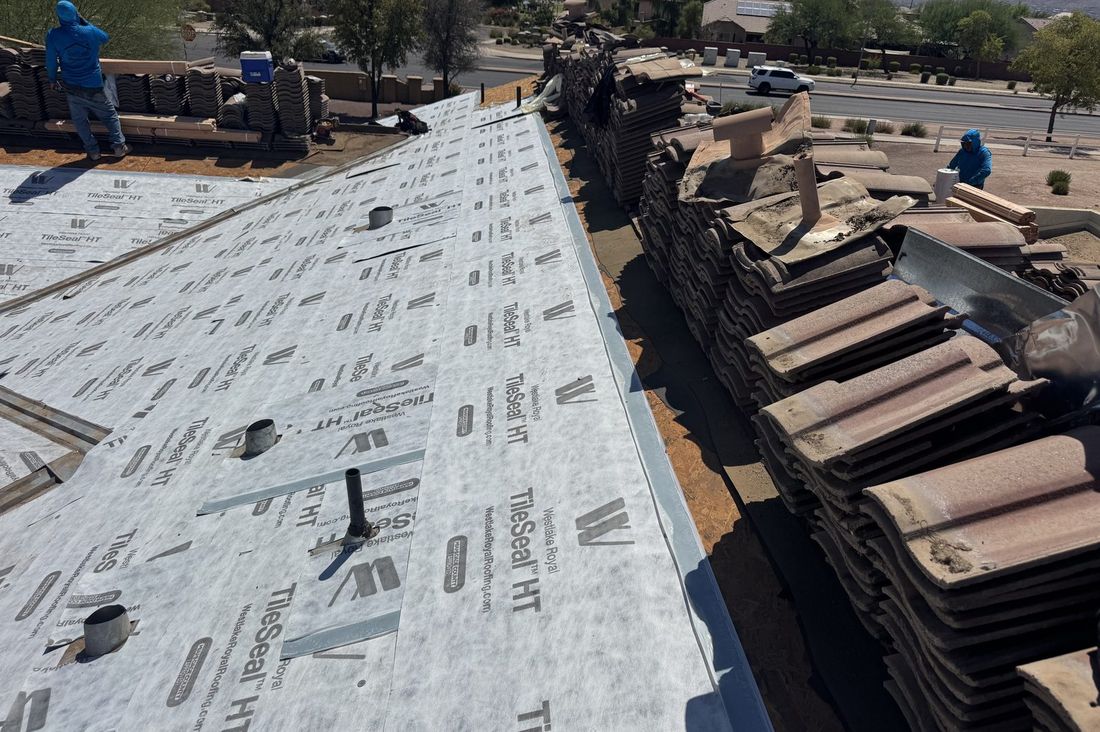
Because there is about twice as much tile to take off and put back. Underlayment fails at roughly 20 to 25 years in Arizona heat regardless of what sits on top of it, so a clay roof will eventually need the tile lifted, the underlayment replaced, and the tile re-laid. On a two-piece mission roof that is double the handling, and brittle sand-cast tile means budgeting for some breakage. It is still far cheaper than replacing a roof whose tile has decades of life left.
Water coming in, a stain on the ceiling, or tile on the ground after a storm — four different problems, one call. Free inspection, photographs of what we actually find, and an honest answer about whether you need the work.
Learn more →When repairs no longer make sense, our crews handle complete tear-offs and new roof installations for homes, new construction, and commercial buildings across the Valley.
Learn more →As a residential roofing company built for the Valley's climate and HOA communities, we help homeowners repair, maintain, and replace roofs with materials suited to Arizona heat.
Learn more →Get a free, no-pressure roof inspection and written estimate from a local Phoenix roofing crew.
Call (480) 331-1017 Request Free Estimate